

In February 2026, non‑US search giants quietly made some of the most consequential AI moves in the market. While attention often fixates on Google and OpenAI, platforms like Baidu, Naver, Alibaba, Yandex, Swisscows, and Cốc Cốc are turning AI into search surfaces, super‑apps, and agentic commerce layers. Their February announcements show a clear pattern:
AI is no longer a bolt‑on chatbox but the operating system for discovery, transactions, and ecosystem control.
Baidu: AI as Core Interface, But With Revenue Pain
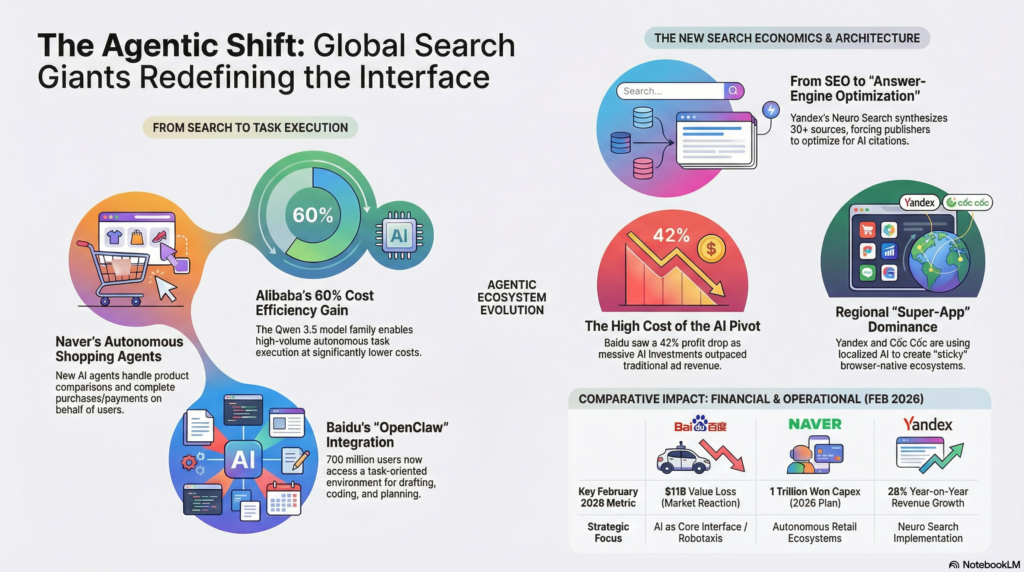
Baidu spent February 2026 pushing its AI assistant deeper into its primary consumer interface while grappling with the financial drag of that strategy. On 13 February, it enabled users to access its OpenClaw AI assistant directly inside the main Baidu search app, effectively turning classic search into a task‑oriented, conversational environment for around 700 million monthly active users. Users can now ask the app to draft content, organize documents, write or debug code, or handle planning tasks, all from within the standard Baidu search experience.
A few days later, Baidu highlighted a more global AI footprint with Apollo Go robotaxis entering Dubai (via an Uber partnership) and the launch of BaiduWiki, a global, AI‑powered encyclopedia designed to compete with both traditional knowledge graphs and generative answer layers. This positions Baidu’s AI as infrastructure for mobility and factual reference, not just chat.
Financially, February’s earnings print underscored the cost of this pivot. Revenue fell about 4% year‑on‑year and profit dropped roughly 42%, as AI and cloud investments failed to offset a weakening advertising business. The market reaction was sharp, wiping around 11 billion USD from Baidu’s value in a short window and raising questions about whether AI is accretive fast enough to justify the spend. Nonetheless, Baidu’s board simultaneously authorized a new share buyback of up to 5 billion USD, using capital strategy to signal confidence in its AI path even as short‑term profitability suffers.
Naver: From AI Briefing to Agentic Commerce
Naver’s February story is about turning AI from a summarization layer into an agent that drives commerce and time‑on‑platform. AI Briefing, which surfaces AI‑generated summaries at the top of search results, now covers roughly 20% of integrated search queries and has more than doubled long‑tail queries of 15+ characters compared to April 2025. This suggests that when users trust Naver to interpret complex queries, they are willing to type richer, more conversational tasks.
In early February, Naver reported record 2025 revenue, attributing a meaningful share of growth to AI‑driven services and signaling heavy 2026 capex—over 1 trillion won—into GPUs and infrastructure for AI agents. Management outlined a near‑term roadmap: a Shopping AI Agent entering internal closed beta in early February, with public launch targeted for late February, designed to handle use cases such as product comparison, recommendation, and even completing purchases and payments on behalf of users.
Beyond search and shopping, Naver is preparing an AI Tab that unifies search, commerce, maps, and payments into a single agentic experience in the first half of 2026. Strategically, this shifts Naver from a search portal to an orchestrator of tasks: the agent becomes the user’s interface to the Naver ecosystem, echoing the “super‑app with AI at the center” direction emerging in other markets.koreajoongangdaily.
Alibaba: Qwen 3.5 and the “Agentic AI Era”
Alibaba used February to reframe its AI ambitions around agents rather than just models. On 16 February, it launched the Qwen 3.5 model family, explicitly branding it as built for the “agentic AI era.” Qwen 3.5 expands beyond text to support multimodal inputs—text, images, and videos—and is engineered for autonomous task execution in both consumer and enterprise workflows.
Technically and commercially, Qwen 3.5 promises lower costs and higher throughput: reports indicate up to about a 60% reduction in use‑case costs and the ability to handle roughly eight times the workload of earlier versions. The model supports around 201 languages and dialects, and Alibaba is releasing it in both open‑weight form and as a managed cloud service, giving developers flexibility over where and how to deploy.
Alibaba also leaned into consumer‑commerce experimentation. Chinese New Year campaigns used Qwen‑powered chatbots to distribute food‑and‑beverage coupons, resulting in a reported seven‑fold jump in active users during the promotional period. This illustrates the company’s thesis that AI chat surfaces can be conversion engines for offline commerce, not just engagement toys.
Yandex: AI Super‑App and Answer‑Engine Optimization
Yandex’s February focus is an AI‑centered super‑app strategy, particularly in Türkiye. Yandex Türkiye announced a localized “Yandex AI” service that bundles chat, an AI assistant, and AI‑enhanced search into a single interface, retrained on Turkish‑language data and tuned for local context. This is a deliberate attempt to differentiate from global models by being deeply local and integrated into everyday life.
A February deep dive on Yandex’s broader roadmap describes an “AI Super App” architecture built on three pillars: YandexGPT 5 (large language model), a multimodal Alice assistant, and YandexART for generative imagery and content. At the core of this stack is “Neuro Search,” which reads dozens of sources—often around 30 per query—to synthesize a single answer, accompanied by citations.
For publishers and SEO, this is significant: Yandex is actively steering the market from traditional blue‑link SEO towards answer‑engine optimization (AEO), where success depends on being included and cited inside synthesized answers. Financially, Yandex reinforced confidence in this strategy by reporting a 28% year‑on‑year jump in Q4 revenue in mid‑February and recommending a dividend of 110 rubles per share, underlining AI as a revenue driver rather than purely a cost center.
Swisscows: Stable, Privacy‑First Positioning
Unlike the others, Swisscows did not ship major new AI features during February 2026, but its positioning continues to matter in the wider AI‑search conversation. Coverage around this period reiterates Swisscows as a privacy‑first, family‑friendly search engine that emphasizes semantic search without user profiling, tracking cookies, or behavioral targeting. This stands in deliberate contrast to the data‑hungry strategies of larger AI platforms.
On the geopolitical side, Switzerland announced that Geneva would host a Global AI Summit in 2027, further cementing the country as a neutral hub in AI governance debates. While not a Swisscows‑specific initiative, this broader national framing reinforces the brand narrative of Swiss AI services as privacy‑respecting and governance‑aware, which Swisscows can leverage as AI search becomes more tightly scrutinized.
Cốc Cốc: AI as a Browser‑Native Layer
Cốc Cốc’s February story is quieter but still relevant for how regional players are packaging AI. Its AI presence centers on the Cốc Cốc browser and mobile app, which include an integrated Vietnamese‑language AI Chat assistant and an AI Search Summarizer. The chat assistant is positioned as a GPT‑3.5‑class helper for drafting, translation, and Q&A in Vietnamese, while the summarizer surfaces how‑to and informational answers at the top of search results pages.
There were no widely reported, February‑dated AI product launches or major architecture overhauls for Cốc Cốc in mainstream tech or financial media. Instead, the platform continues to promote and iterate on its existing AI browser features, effectively using AI as a stickiness layer in a competitive Vietnamese search and browser market. This underlines a pattern common to smaller ecosystems: AI is a differentiator for local UX rather than the basis of a global super‑app play—at least for now.
Overall, February 2026 shows regional search and super‑app players converging on a similar direction: AI as the primary interaction layer, agents as the bridge to commerce and services, and answer‑style search that forces brands and publishers to think beyond traditional SEO. For someone building frameworks around AI visibility and agentic commerce, the through‑line is clear: every one of these ecosystems is quietly redefining what “search” means inside its own walled garden.

